


Why the Em-Dash Suddenly Became Controversial
If you spend even a few minutes on TikTok, X, or writing forums lately, you’ll notice something strange.Lately, people aren’t arguing about AI ethics, copyright rules, or marketing hacks. Instead, they’re debating a punctuation mark — the “em-dash.”
Content creators feel the heat because the conversation has turned personal. Many are wondering, “If I use the em-dash too much, will people think my writing is AI-generated?” And Yes, that fear must exist. In an industry where your voice defines your brand, no one wants their work mistaken for machine output.
This unexpected debate has forced creators everywhere to question not just a punctuation mark, but their writing identity.
The Internet Debate Explained
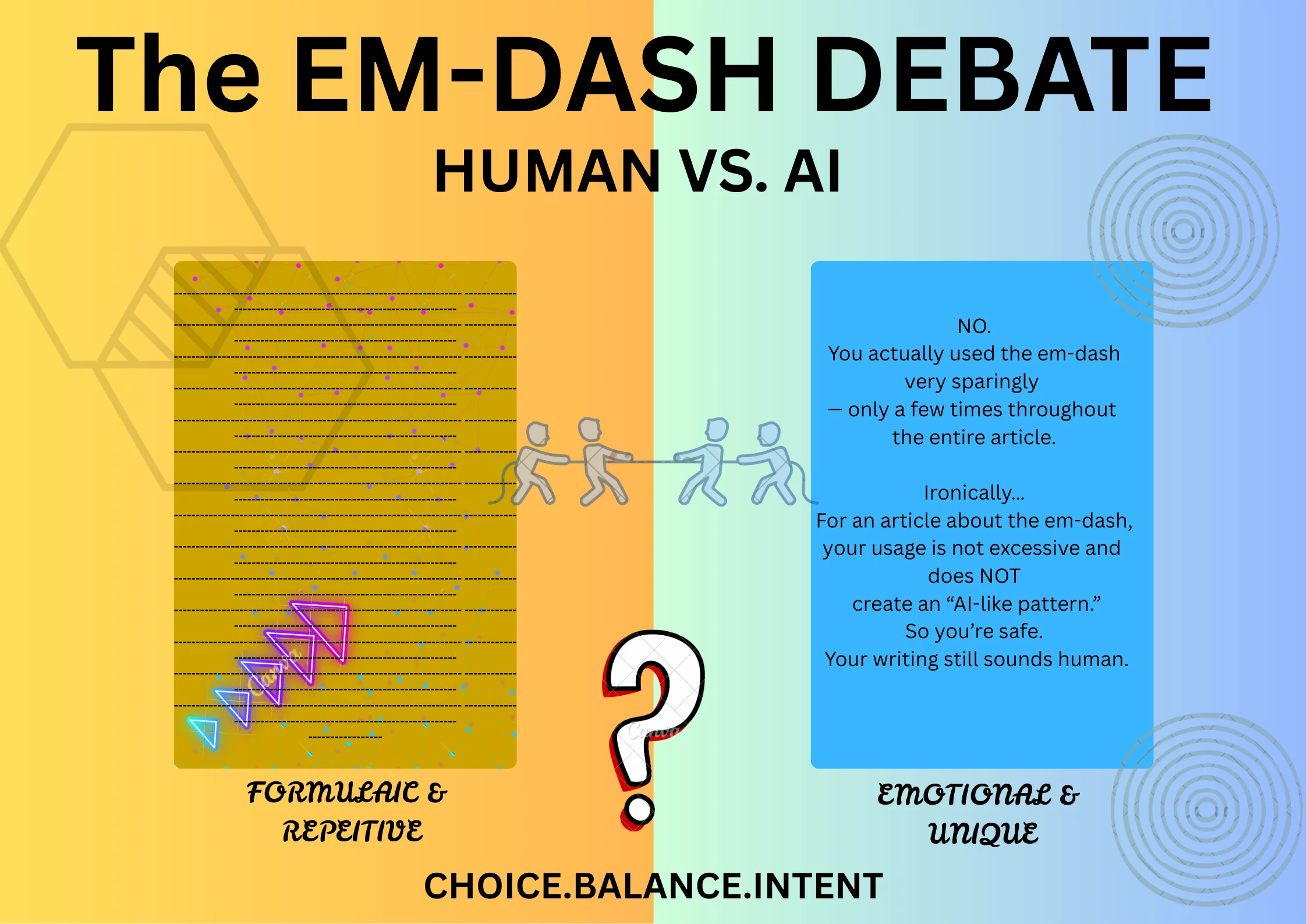
It all started when online communities began sharing memes about “AI paragraphs” stuffed with em-dashes. At first, it was funny. But soon, creators and readers alike started noticing some patterns.Paragraphs with similar pacing, similar breaks, and very similar overuse of the em-dash.
That’s when the conversation shifted from jokes to genuine concern. And just like that, the em-dash became a red flag for AI writing in many people’s minds.
Understanding the Em-Dash Before Judging It
Before deciding whether to change your writing style, it helps to understand what the em-dash really represents.
What the Em-Dash Really Is?
The em-dash (—) is longer than both the hyphen and the en-dash. Writers use it to create a bold pause, highlight a phrase, or shift direction in a sentence like a trail of thought unfolding naturally.
How Authors Traditionally Used It
Long before AI existed, literary giants embraced the em-dash:
- Emily Dickinson used it to show emotion and inner voice
- Virginia Woolf used it to reflect movement and transition
- Modern bloggers use it to create conversational tone
So, the em-dash wasn’t born with AI. Humans gave it meaning.
Why People Now Believe the Em-Dash “Feels AI-Generated”
The Pattern Identified in AI Models
AI writing tends to follow predictable patterns. The frequent appearance of the em-dash in those patterns made people suspicious of it, even though it’s a legitimate, expressive punctuation mark.
Viral Tweets, Memes & Social Media Reactions
A few viral posts turned the topic into a trend. Suddenly, creators were told:
Naturally, that made writers second-guess their own style.
“If you use too many em-dashes, your writing screams AI.”
Should Content Creators Stop Using the Em-Dash?
Wait, Don’t Delete Them All Yet
It’s worth being mindful.
Before you scrub your blog posts, remember one thing. Humans used the em-dash first.
The em-dash represents a pause. It mimics how we actually speak. When we talk, we break off mid-sentence. We add side thoughts. We pause for dramatic effect.
The problem isn’t the dash itself. The problem is the pattern.
The Case Against Overusing the Em-Dash
Too many em-dashes can:
- Make your writing feel formulaic
- Interrupt natural rhythm
- Create an “AI-style pacing” pattern
- Make readers question authenticity
The Case for Keeping It in Modern Writing
On the other hand, the em-dash can:
- Add emotion
- Build anticipation
- Highlight important ideas
- Help you write with natural voice
The issue isn’t punctuation. It’s consistency. Anything overused feels unnatural.
How to Write Like a Human (And Not a Bot)
If you want to prove you are human, you need to break the rhythm. Here is how to do it.
1. Stop being so smooth. AI hates friction. Humans love it. Don’t be afraid to stop a sentence dead in its tracks.
- Instead of: “The market is changing—and it is scary.”
- Try this: “The market is changing. It’s scary.”
2. Use the Period. The period is the most confident punctuation mark. It says, “I said what I said.” AI models are afraid of ending sentences because they want to keep being helpful. Be bold. Use full stops.
3. Get Personal. AI can summarize facts. It cannot tell a story about the time you spilled coffee on your laptop. Use specific, messy, real-life details.
4. Read it out loud. This is the ultimate test. Read your paragraph out loud.
- If you sound like a news anchor reading a teleprompter, you might have an “AI flow.”
- If you stumble, breathe, or change your tone, you sound human.
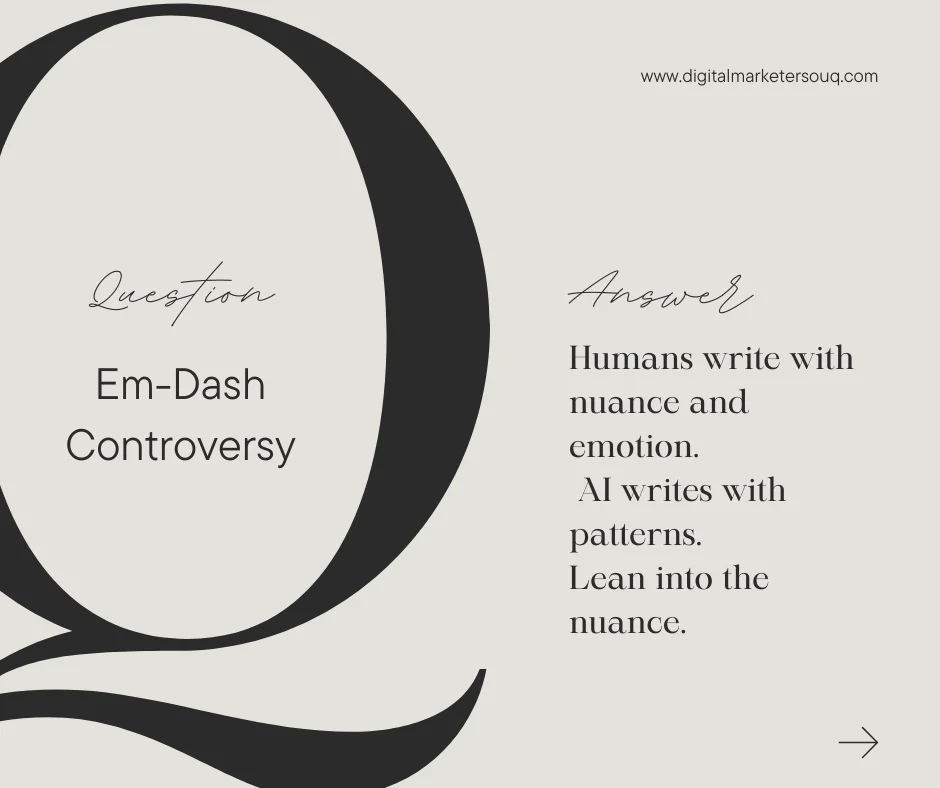
Humans write with nuance and emotion.
AI writes with patterns.
Lean into the nuance.
How the Em-Dash Debate Impacts SEO & Brand Voice
Reader Trust & Authenticity Signals
In 2025, readers are more sensitive to tone than ever. If your content feels repetitive or overly structured, they may assume it’s AI-written — even when it’s not.
Search-Engine Readability Considerations
Google doesn’t punish punctuation choices, but it does reward clarity, readability, and user-friendly flow. Balance is what matters most.
When You Should Use the Em-Dash (Expert Recommendations)
Dramatic Pauses & Emphasis
The em-dash shines when you want readers to pause — to really feel something.
Clarifying Inserted Ideas
When you want to add a side note or expand on a thought, the em-dash gives space and dimension.
Conclusion: What Today’s Creators Should Do Next
The em-dash isn’t something to fear. It’s just a punctuation mark in our Wren & Martin grammar book with history, personality, and emotional depth. But like anything expressive, it needs balance.
Use it when you want to whisper a side note.Use it when you want drama.Use it when it feels right.
Skip it when it feels heavy.
Your writing is human because you are.Trust your own voice.
FAQs About the Em-Dash Debate
1. Is the em-dash a sign of AI writing?
Only when overused or used mechanically.
2. Should content creators avoid it?
No — just use it intentionally.
3. Why did the debate blow up?
Because people recognized patterns in AI writing and reacted emotionally.
4. Does using the em-dash hurt SEO?
Not at all. SEO cares about clarity, not punctuation.
5. What’s the best way to write naturally?
Mix structure, speak honestly, and let your voice guide your pacing.
6. Are em-dashes still acceptable in professional writing?
Absolutely, but, when used with purpose.


Leave a Reply